
Definition of a Clarifier
Clarifier, also known as a sedimentation tank, is one of the most common and fundamental solid-liquid separation units in water treatment systems.
It utilizes the principle of gravitational settling to separate suspended solids, biological sludge, or flocs formed after coagulation from the liquid, thereby producing relatively clear effluent.
The Function of Clarification Tanks
In water supply and wastewater treatment, clarification tanks are typically used for:
- Removing suspended solids (SS).
- Removing coagulated flocs.
- Separating activated sludge from biological treatment systems.
- Reducing operational loads on subsequent filtration and membrane systems.
Working Principle of Clarifiers
The clarifier operates on the principle of gravitational settling. When water containing suspended solids enters the clarifier tank at a low flow rate: the flow velocity rapidly decreases, and particles denser than water gradually sink under gravity. Settled sludge accumulates at the tank bottom, where a scraper pushes it into a sludge hopper for discharge. Clear liquid uniformly overflows from the weir or collection channel.
This entire process requires no complex energy input. Efficient solid-liquid separation is achieved through rational hydraulic design, adequate retention time, and appropriate surface loading rates.
Why do We Need Clarifiers?
In virtually all water treatment systems, clarifiers are indispensable for four primary reasons:
- Enhance Overall Treatment Efficiency
Removing most suspended solids in advance significantly improves the stability of subsequent processes. - Reduce Operating Costs
Decrease filter backwashing frequency and extend membrane service life. - Improve System Reliability
Prevent membrane fouling or equipment clogging caused by suspended solids surges. - Meet Effluent Quality Requirements
Serves as a critical pretreatment unit for compliant discharge or reclaimed water.
Types of Clarifiers
Circular Clarifier
- Primarily used in municipal wastewater treatment plants.
- Peripheral drive or center drive.
- Stable operation and proven maintenance.
Rectangular Clarifier
- Suitable for industrial projects with high water flow rates.
- Uniform hydraulic conditions.
- Easy to expand with modular design.
Lamella Clarifier
- Compact footprint, high surface load.
- Ideal for retrofit projects and compact systems.
High-Rate Clarifier
- Integrated coagulation, reaction, and sedimentation.
- Suitable for enhanced pretreatment systems.
Typical Application Scenarios for Clarifiers
- Municipal Water Treatment Plant (Coagulation and Sedimentation).
- Municipal Wastewater Treatment Plant (Primary Settling Tank, Secondary Settling Tank).
- Industrial Wastewater Treatment System.
- High-Salinity Wastewater and ZLD Pretreatment.
- Chemical Softening and Hardness Removal System.
- Membrane System (RO/UF) Pretreatment.
Clarifier vs. Other Solid-Liquid Separation Equipment
In water treatment systems, clarifiers are not the only equipment used to achieve solid-liquid separation.
Depending on water quality characteristics, treatment objectives, and effluent requirements, other equipment such as thickening tanks, dissolved air flotation units, filters, and centrifuges are also commonly employed in engineering applications.
Clarifier vs Thickener
| Item | Clarifier | Thickener |
|---|---|---|
| Primary Purpose | To produce clarified effluent | To produce high-concentration sludge |
| Main Focus | Effluent water quality | Underflow solids concentration |
| Surface Loading Rate | Low to medium | Low |
| Sludge Concentration | Relatively low (1–3%) | Relatively high (3–10% or even higher) |
Table of Clarifier vs Thickener
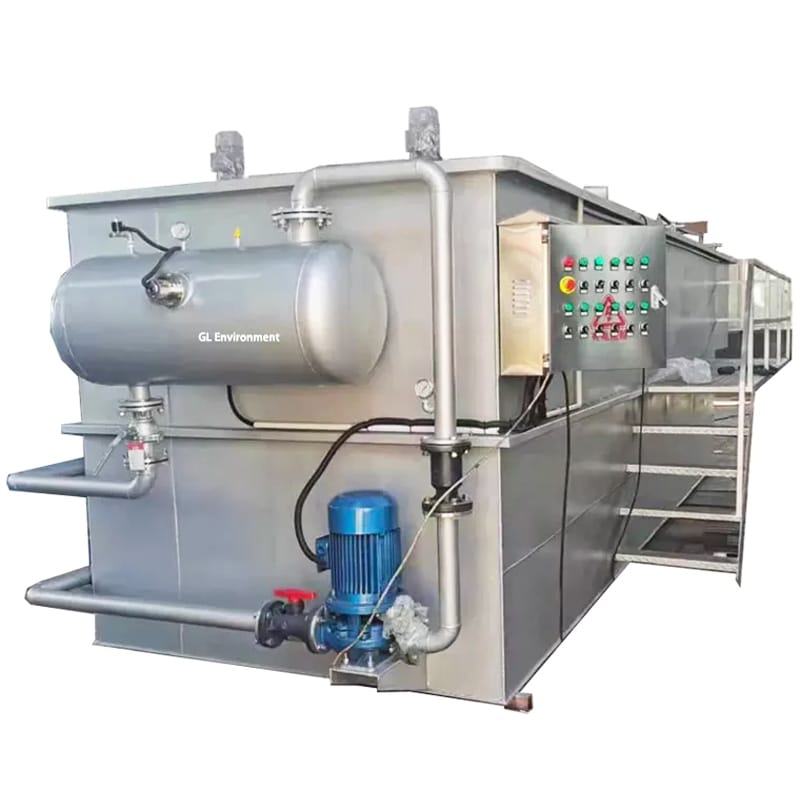
Clarifier vs DAF
| Item | Clarifier | Dissolved Air Flotation (DAF) |
|---|---|---|
| Separation Mechanism | Gravity settling | Microbubble flotation |
| Suitable Particles | Dense, easily settleable particles | Light particles, oils, and flocs |
| Energy Consumption | Low | Medium |
| Footprint | Relatively large | Relatively small |
| Adaptability to Influent Fluctuations | Medium | High |
Table of Clarifier vs DAF
Clarifier vs Centrifuge
| Item | Clarifier | Centrifuge |
|---|---|---|
| Separation Mechanism | Gravity settling | Centrifugal force |
| Energy Consumption | Extremely low | Very high |
| Capital Cost | Low to medium | High |
| Operating Cost | Low | High |
| Continuous Operation Capability | Strong | Moderate |
| Typical Applications | Large flow rates, low to medium solids concentration | High-solids, hard-to-settle sludge |
Table of Clarifier vs Centrifuge
Conclusion
The clarifier is one of the most fundamental and critical solid-liquid separation units in water treatment systems. It achieves efficient separation of suspended solids from water through gravitational settling, providing stable and reliable feed water quality for subsequent filtration, membrane separation, and disinfection processes. Whether in municipal water supply, industrial wastewater, or Zero Liquid Discharge (ZLD) and high-salinity wastewater systems, the clarifier plays an irreplaceable role.
Manufacturers like kuosi are committed to providing durable, efficient, and application-specific solid-liquid separation solutions to meet the evolving demands of modern wastewater treatment facilities. Contact us for customized solutions!