

A sludge dewatering screw press can operate continuously with relatively limited operator attention. However, unstable sludge characteristics, incorrect polymer dosing, insufficient washing or unsuitable operating settings can quickly reduce dewatering performance.
Common warning signs include:
- Wet or sticky sludge cake
- Excessive suspended solids in the filtrate
- Reduced sludge throughput
- High polymer consumption
- Sludge overflowing from the flocculation tank
- Motor overload or abnormal noise
Effective screw press troubleshooting should start with the process conditions rather than immediate mechanical adjustment. In many cases, the press itself is operating correctly, while the actual cause is unstable feed sludge or poor flocculation.
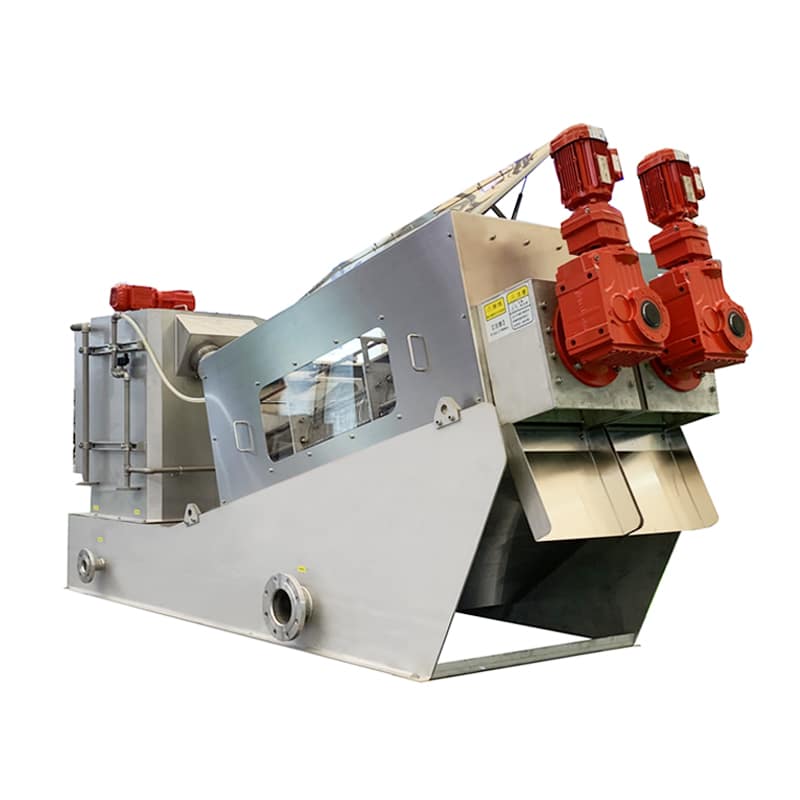
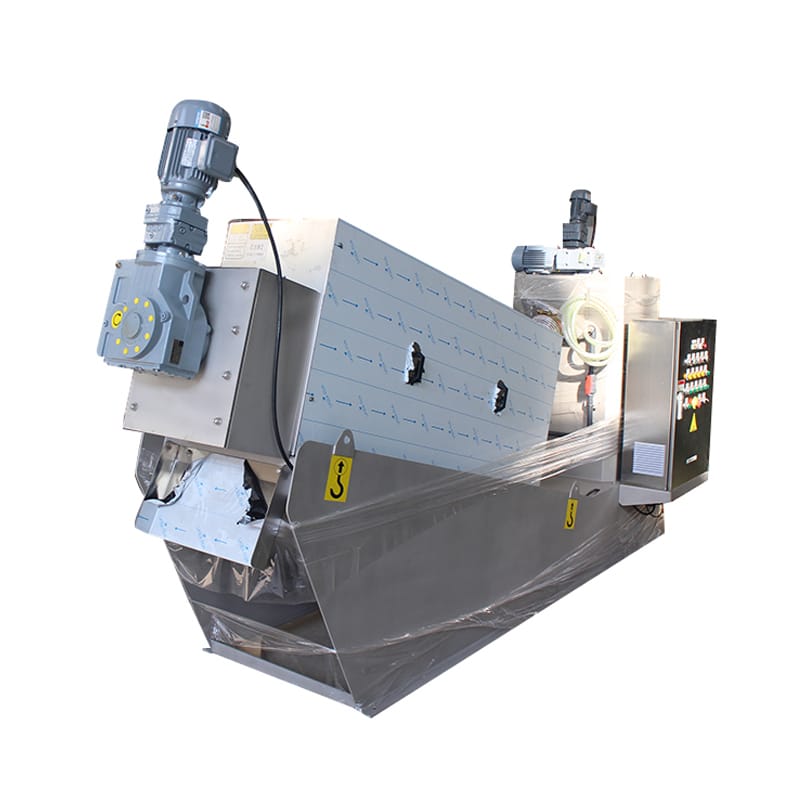
Quick Screw Press Troubleshooting Table
| Problem | Likely cause | Recommended action |
| Wet sludge cake | Poor flocculation, excessive feed rate or insufficient backpressure | Check polymer, reduce feed and adjust end-plate pressure |
| Dirty filtrate | Small or weak flocs, polymer underdosing or excessive screw speed | Repeat jar testing and reduce throughput |
| Low capacity | High sludge viscosity, blockage or insufficient feed | Check sludge line, rings, spray nozzles and pump |
| High polymer consumption | Incorrect polymer or poor solution preparation | Optimize polymer type, concentration and aging |
| Sludge overflow | Feed rate exceeds hydraulic capacity | Reduce pump flow and check return pipe |
| Motor overload | Excessive solids load or internal obstruction | Stop the unit and inspect the screw and rings |
| No sludge cake discharge | Insufficient feed, no floc formation or excessive end pressure | Check feed pump, polymer system and discharge gap |
| High wash-water use | Spray cycle too frequent or nozzles partially blocked | Clean nozzles and optimize timer settings |
| Abnormal noise | Foreign object, worn component or loose connection | Stop and inspect before restarting |
| Unstable automatic operation | Faulty sensor, incorrect interlock or unstable level | Check signals, wiring and control parameters |
Why Is the Screw Press Producing Wet Sludge Cake?
Wet sludge cake is one of the most common screw press problems. It does not always indicate a mechanical failure.
Possible causes
- Feed sludge solids concentration is too low
- Polymer dosage is insufficient
- The selected polymer is unsuitable for the sludge
- Flocs are too small or fragile
- Sludge feed rate is too high
- Screw rotation speed is too high
- End-plate pressure is insufficient
- Sludge composition has changed
A screw press depends on effective conditioning before the sludge enters the dewatering section. The sludge and polymer must form stable flocs that release free water under gravity and compression.

Corrective actions
First, inspect the flocs inside the mixing tank. They should be clearly visible and sufficiently strong to remain intact while entering the screw.
Then:
- Conduct a jar test using several polymer dosages.
- Check the polymer solution concentration and maturation time.
- Reduce the sludge feed rate by approximately 10% at a time.
- Reduce screw speed gradually to increase retention time.
- Increase end-plate pressure in small increments.
- Measure feed solids and cake solids rather than judging performance only by appearance.
Do not increase backpressure aggressively. Excessive pressure can restrict cake discharge and increase motor load.
Why Does the Filtrate Contain Too Many Solids?
The filtrate should not necessarily be completely clear, but a sudden increase in suspended solids normally indicates poor solids capture.
Possible causes
- Polymer underdosing
- Incorrect polymer charge or molecular weight
- Insufficient polymer aging
- Excessive mixing that breaks the flocs
- Feed flow exceeding the design capacity
- Screw rotating too quickly
- Ring gaps containing hardened deposits
- Abnormal wear in the dewatering section
Corrective actions
Observe the sludge at three positions:
- Before polymer addition
- At the outlet of the flocculation tank
- Inside the gravity drainage zone
f good flocs form in the tank but disappear before entering the press, excessive shear is likely. Reduce mixer speed or inspect the transfer path for restrictive valves and high-speed pumping.
If no clear flocs form, review the polymer before adjusting the screw press.
A polymer preparation system should provide a homogeneous, properly activated solution. KUOSI systems can prepare and dose powder or liquid polymer automatically.
Why Has Screw Press Capacity Decreased?
Reduced capacity can result from either a hydraulic restriction or a change in dry solids loading.
The dry solids load is calculated as:
Dry solids load, kg DS/h = sludge flow, m³/h × solids concentration, kg/m³
For example, a flow increase from 2 to 3 m³/h does not fully describe the additional load. If solids concentration also doubles, the dry solids load may exceed the machine’s capacity even though the hydraulic flow appears acceptable.
Possible causes
- Feed sludge has become thicker or more viscous
- Dry solids load exceeds the selected model capacity
- Sludge feed pump is worn or blocked
- Pipeline or valve is partially obstructed
- Moving and fixed rings contain deposits
- Spray nozzles are blocked
- End-plate gap is too narrow
- Sludge cake accumulates at the discharge outlet
Corrective actions
- Measure actual sludge flow and feed solids concentration.
- Check the feed pump pressure and delivered flow.
- Inspect the sludge inlet, valves and return line.
- Run the automatic washing cycle.
- Manually clean the rings if automatic washing is insufficient.
- Check whether sludge can leave the discharge outlet freely.
- Compare the actual dry solids load with the selected equipment rating.
Do not use only m³/h when assessing capacity. Screw presses should be selected and evaluated using both hydraulic flow and kg DS/h.
Why Is Polymer Consumption Too High?
Increasing polymer dosage may temporarily improve cake formation, but overdosing creates other problems.
Typical signs of polymer overdosing include:
- Sticky or gelatinous sludge cake
- Slippery filtrate
- Polymer residue on the rings
- Increased cleaning frequency
- High operating cost without a proportional improvement in cake solids
Possible causes
- Polymer type is unsuitable
- Polymer solution is too concentrated
- Powder is not fully dissolved
- Aging time is insufficient
- Dosing pump calibration is incorrect
- Feed sludge concentration changes frequently
- Polymer and sludge are mixed with excessive or insufficient energy
Corrective actions
- Verify the polymer preparation concentration.
- Check powder feeder and dilution-water calibration.
- Confirm sufficient solution maturation.
- Calibrate the polymer dosing pump.
- Perform jar tests using different polymer types and dosages.
- Express consumption as kg of active polymer per tonne of dry solids.
- Adjust dosage according to solids loading rather than wastewater flow alone.
The polymer preparation equipment should also be inspected for clumping, blocked powder outlets and residue inside the screw feeder. KUOSI operating guidance recommends cleaning accumulated powder and checking the feeder before refilling.
Why Is Sludge Overflowing from the Flocculation Tank?
An overflow usually means the incoming hydraulic load is greater than the flow that can pass through the downstream section.
Possible causes
- Sludge feed rate is too high
- Return pipe is blocked
- Outlet to the dewatering section is restricted
- Large polymer lumps obstruct the pipe
- Level sensor is contaminated
- Automatic control signals are unstable
- Mixer operation produces excessive foam
Corrective actions
- Reduce the feed pump frequency.
- Check all overflow and return pipelines.
- Remove polymer deposits from the tank outlet.
- Clean the level sensor.
- Verify that the screw is operating before sludge feeding starts.
- Confirm that the control sequence follows the required interlocks.
Where the screw press uses a metering tank with a sludge return line, excess sludge should return to the storage tank rather than continuously flooding the flocculation section.
Why Is the Screw Press Motor Overloading?
A motor overload alarm should not be repeatedly reset without finding the cause.
Possible causes
- Excessive feed solids
- End-plate pressure is too high
- Sludge cake cannot discharge
- Foreign material has entered the press
- Hardened sludge is obstructing the screw
- Rings are severely contaminated
- Bearing, gearbox or screw component is damaged
- Electrical voltage is unstable
Corrective actions
- Stop the sludge feed.
- Isolate electrical power according to site safety procedures.
- Release excessive discharge pressure.
- Inspect the cake outlet.
- Check for foreign objects or hardened solids.
- Clean the screw and ring assembly where required.
- Check gearbox oil and mechanical connections.
- Verify motor current after restarting without sludge.
- Restart with a reduced feed rate.
Never place hands or tools into the dewatering section until the equipment has been isolated and locked out.
Why Is No Sludge Cake Coming Out?
The screw may be rotating normally while little or no cake reaches the outlet.
Possible causes
- No sludge is entering the unit
- Feed pump has lost prime
- Sludge solids concentration is extremely low
- Polymer dosing pump is not operating
- Polymer tank is empty
- Flocs are not forming
- End-plate clearance is too narrow
- The discharge zone is blocked
Corrective actions
Check the system in process order:
Sludge storage tank → feed pump → metering tank → polymer dosing → flocculation tank → dewatering zone → cake outlet
Confirm the actual flow at each stage rather than relying only on the control-panel status.
Where feed solids are very low, the press may need a longer operating period before a stable cake forms. However, continuous operation without visible flocculation should be stopped because untreated sludge will pass into the filtrate.
Why Are the Rings or Screen Becoming Blocked?
Multi-disc screw presses use moving and fixed rings to provide filtration and self-cleaning action. Even with this configuration, deposits can accumulate under unsuitable conditions. KUOSI describes the unit as using the small gaps between moving and fixed rings for solid-liquid separation.
Possible causes
- Wash-water pressure is too low
- Spray nozzles are blocked
- Washing intervals are too long
- Polymer is overdosed
- Sludge contains grease, fibers or sticky material
- Equipment remains full of sludge after shutdown
- Hard mineral deposits have developed
Corrective actions
- Check wash-water pressure while the spray system is operating.
- Remove and clean blocked nozzles.
- Shorten the wash interval temporarily.
- Reduce polymer overdosing.
- Flush the equipment after shutdown.
- Use a cleaning method compatible with the ring and seal materials.
- Inspect ring movement and wear.
High-pressure cleaning should not be directed at electrical components, sensors or seals unless the equipment documentation specifically permits it.
Why Is the Screw Press Making Abnormal Noise?
A screw press normally operates at low rotational speed. New grinding, knocking or metallic noise should therefore be investigated immediately.
Possible causes
- Foreign object inside the press
- Loose motor or gearbox mounting
- Misalignment
- Damaged bearing
- Worn screw or ring assembly
- Sludge cake accumulation at the outlet
- Insufficient gearbox lubrication
Corrective actions
Stop the unit and determine where the sound originates. Inspect:
- Motor and gearbox
- Coupling
- Screw shaft
- Moving and fixed rings
- Discharge end plate
- Fasteners and support frame
Do not continue operation where metal-to-metal contact, severe vibration or rapid temperature increase is present.
Why Is Automatic Operation Unstable?
A screw press may start and stop unexpectedly when sensor signals or interlocks are inconsistent.
Possible causes
- Incorrect high- or low-level signal
- Level sensor covered by sludge
- Feed pump remote signal missing
- Polymer system not ready
- Wash-water pressure switch alarm
- Motor overload relay activated
- Incorrect timer or variable-frequency-drive settings
- Loose electrical connection
Corrective actions
- Clean and test level sensors.
- Confirm each manual function separately.
- Review the PLC alarm history.
- Check communication and remote-start terminals.
- Verify the operating sequence.
- Compare VFD settings with the commissioning record.
- Inspect terminal connections with power isolated.
- Restore one automatic function at a time.
The operator should avoid changing several parameters simultaneously. Record each adjustment and allow the process to stabilize before evaluating the result.
A Practical Diagnostic Sequence
When performance drops, follow these steps:
- Check feed sludge: flow, solids concentration and basic characteristics.
- Check flocculation: polymer type, dosage and floc quality.
- Check operating settings: screw speed, feed rate and pressure.
- Inspect equipment: nozzles, rings and discharge outlet.
- Measure results: cake solids, filtrate quality and polymer use.
This helps identify whether the issue is process-related or mechanical.
Preventive Maintenance Checklist
Preventive maintenance of a screw press should be done regularly to keep it running well and extend its service life. Daily tasks include observing sludge floc formation, checking sludge cake and filtrate quality, recording key data such as feed rate, polymer dosage and motor current, ensuring spray nozzles work properly, and checking for leaks or unusual noise.
Weekly maintenance includes cleaning spray nozzles and sensors, inspecting the flocculation tank and mixer, checking sludge and polymer pipelines, examining the discharge outlet, and testing manual and automatic controls.
Monthly maintenance focuses on checking the moving and fixed rings, inspecting the screw shaft, checking gearbox oil, tightening connections, and calibrating feed and polymer dosing systems.
During long shutdowns, stop sludge and polymer feeding, flush pipelines, clean the flocculation tank, run the washing cycle, remove residual sludge, and isolate power while protecting the equipment from damage.

Summary
KUOSI can review sludge data, operating records and required throughput to identify whether the problem relates to polymer conditioning, equipment settings, system capacity or component wear. Contact for engineering solution when troubleshooting an existing screw press, polymer preparation system or integrated sludge treatment line. KUOSI also provides a wide range of other water and wastewater treatment equipment, including dissolved air flotation systems, chemical dosing units, sludge thickening solutions and integrated treatment systems. These products can be combined with screw press dewatering to form a complete and efficient treatment process tailored to different industrial and municipal applications.